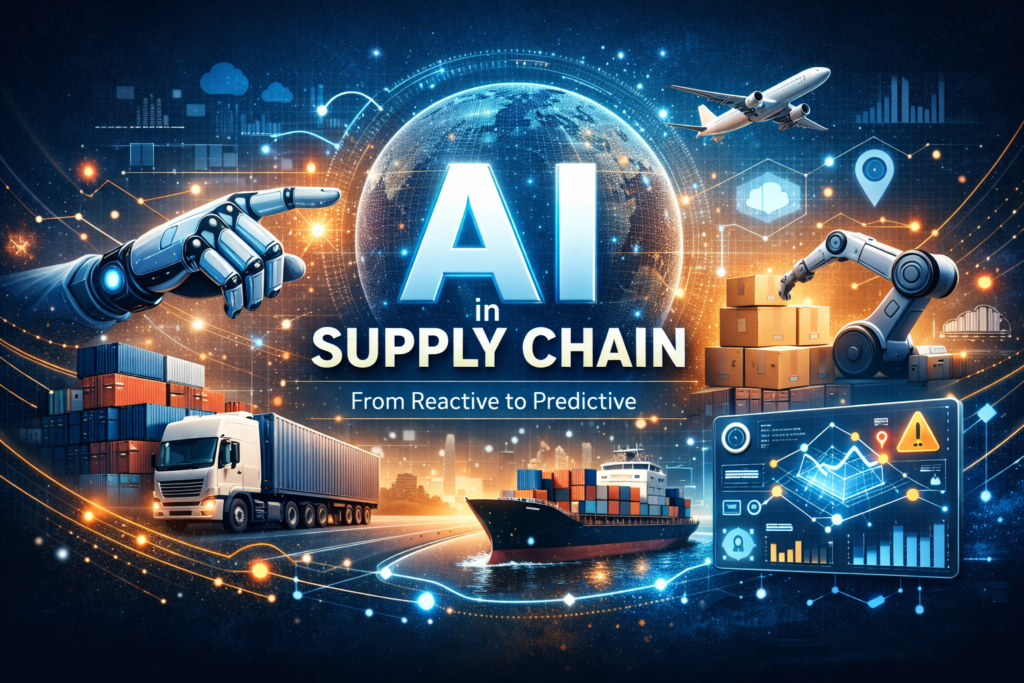
Artificial Intelligence (AI) is rapidly transforming the way supply chains operate. Traditionally, supply chains have depended on historical data, manual planning, and fixed rules to make decisions. While this worked in stable environments, today’s world is far more unpredictable. Demand fluctuations, supplier disruptions, logistics delays, and rising customer expectations have made reactive supply chains inefficient and costly.
AI helps shift supply chains from being reactive to being predictive. Instead of only looking at past data, AI systems continuously learn from real-time information such as sales trends, seasonality, promotions, weather patterns, and external market signals. This allows companies to forecast demand more accurately and adjust plans before problems occur, reducing both excess inventory and stockouts.
Inventory management is another area where AI creates significant impact. Traditional inventory models rely on static safety stock rules, which often lead to overstocking or poor availability. AI-driven systems dynamically decide how much inventory to hold and where to place it across the supply network. By balancing demand uncertainty, lead times, and service-level goals, businesses can improve product availability while freeing up working capital.
AI also improves logistics and transportation by making smarter, faster decisions. It can predict delivery delays, optimize routes in real time, and suggest better load consolidation strategies. By factoring in traffic, fuel costs, weather conditions, and carrier performance, AI helps reduce transportation costs while improving delivery speed and reliability.
Supplier management has become increasingly complex, and AI plays a key role in building resilient supply chains. AI tools monitor supplier performance, financial health, and external risk signals such as geopolitical events or market disruptions. This allows companies to identify risks early and take proactive actions like diversifying suppliers or adjusting sourcing strategies.
Beyond planning and optimization, AI automates many operational tasks within the supply chain. Activities such as purchase order creation, exception handling, and routine communication with vendors can be handled by AI-driven systems. This reduces manual effort, speeds up decision-making, and allows supply chain teams to focus on strategic initiatives instead of daily firefighting.
It is important to note that AI does not replace supply chain professionals. Instead, it supports better decision-making. AI is excellent at analyzing large volumes of data and running multiple scenarios quickly, while humans bring judgment, context, and strategic thinking. The most successful organizations combine AI insights with human expertise to achieve better outcomes.
Despite its benefits, adopting AI in supply chains comes with challenges. Poor data quality, fragmented systems, lack of skilled talent, and resistance to change can slow down implementation. Companies that succeed usually start with clear use cases, invest in strong data foundations, and focus on building trust in AI-driven recommendations.
Looking ahead, the future of supply chains lies in intelligent and adaptive systems. These supply chains will be able to sense disruptions, simulate different scenarios, and respond automatically with minimal human intervention. As AI continues to evolve, supply chains will move beyond cost optimization and become a key source of competitive advantage.
In conclusion, AI is no longer an optional technology in supply chain management. It has become essential for building agility, resilience, and efficiency in an uncertain world. Organizations that embrace AI early will be better prepared to meet customer expectations and navigate future disruptions with confidence.